“Energy craves form but more than that loves….metamorphoses.” Michael Taussig I’m in the rocking chair that sits in our bedroom, listening through the open window to canned children’s songs being pumped through a PA at the playground of the preschool next door. So simple and effective. The kids know every tune by heart. And now so do I.
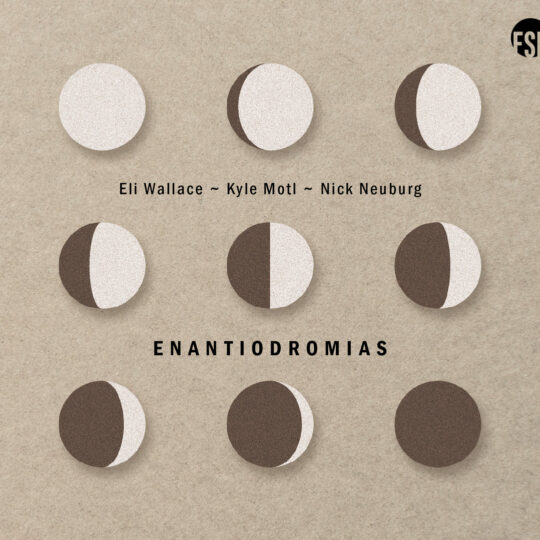
Children’s songs lodge themselves in your memory, and it is wickedly easy to describe every facet of their construction. And that modesty—sing-song diatonic melody, I-V-I harmony, waltz or march time—is haunting me. I’ve been rocking in this chair for an hour trying to articulate what it is that makes the improvisations on Enantiodromias so special. As opposed to the obviousness of children’s tunes, describing the music of Eli Wallace, Kyle Motl, and Nick Neuburg is a task rather like diagramming the movement of a dozen ducklings in a small yellow box—piling, complex, and defying easy definition. And yet it does share one trait with the treacly sweet songs still cycling among the swings and slides: it is a kind of nourishment for growth.
Writing about music involves a certain amount of permeation. The children next door carry their new and fleeting memories of birthday parties and playground slights, and I listen to an improvisation like “Unformed, yet fixed” with my own, now ponderous, experience. A thin green volume of essays by anthropologist Michael Taussig is sitting next to me now, just as it has been all week as I’ve listened to the trio’s discursive energy music. Because of this, his strange writings on rumor, field notes, and bare asses have become entangled with the music of the trio. I keep coming back to an essay of his called “Mooning Texas” where he outlines a roughly linear catalog of the effects of energy on culture as well as a short digression in praise of floating signifiers (which he calls “fluffy words”). Energy and metonymy, both ideas entertain a dialectical balance between being culturally comprehensive and essentially nonexistent, everything and nothing at the same time.
There’s a connection here, and I’m struggling to put the feeling that this music contains the same tension into words. How are these ideas present in the improvisations of Enantiodromias ? The trio builds its own dialectics to be sure: music that transcends jazz history by holding all of its eras in balance; sound that is equal parts ethereal and earthy, expansive and translucent. But it can’t be that simple.
In his book A General Theory About Magic , Marcel Mauss (another anthropologist) puts forth the term “mana” as “an aether or stream of energy constellated by rite buoyed up by an indefinable sense of the sacred.” Taken out of its original context, that description could have just as easily come from the back of an Alice Coltrane record.
What Mauss’ description and my attempts at describing the music on this disc share in common is a lexical fuzziness, a kind of I-know-these-words-are-hollow-but-you-know-what-I-mean-right? way of talking about improvised music. The undulating velocities of each player, the individual lines ecstatically swirling around each other, and the moment of communion when the trio finds itself as a whole: would it be okay to call a track like “Vertical Secrets” “manaesque”?
I’m not the only one that finds definitions exceedingly hard; anthropologist Claude Levi-Strauss wrote that Mauss’ use of “mana” in A General Theory was an example of the “floating signifier that means nothing and everything and does so with aplomb.” And like “mana” itself, Levi-Strauss’ criticism somehow applies to Enantiodromias . This is “floating signifier” music. It has no easily definable reference point because the group’s raison d’etre is the inclusion of every one of their experiences and every shard of their knowledge.
Because of this breadth, describing the trio’s music can really only be done in metaphor. For example, my listening notes for the disc’s opening track include references to soil, incendiary devices, low-front clouds, 19 th century France, and the play of fast-moving water on pebbles. You have to rely on a collection of “fluffy words,” or signs that mean nothing on their own, but in combination can conjure an image of the vast world that this trio is creating in the moment.
That’s metonymy, but what about energy? There is a simple diagram, C-C 1 , created by Karl Marx that defines capital’s goal— C— as the production of more capital, or C 1 . We all experience the innate truth in this equation, some more brutally than others, but what fascinates is how it elegantly defines a kind of self-sustaining energy, one that reproduces from itself, then spreads and oozes.
This music has that ooze. It perpetuates an idea only to have it become raw material for something new, a tireless cycle of construction, deconstruction, and reconstruction. On the disc’s second track, “Phenomenological hubris,” the trio acts as a room full of clocks ticking, clunking, and chiming at different rates. This confluence of ideas isn’t prepared in advance or the product of luck; it’s the result of multiple streams of improvisatory energy that have perpetuated themselves toward a place that didn’t exist when the trio started playing. This is the magic of improvisation’s energy: I-I 1 , where I 1 stands for something you’ve never heard before.
And what of the people behind that energy? I’ve ignored a big part of my job in not presenting the bios and a few “fluffy words” about pianist Wallace, bassist Motl, and percussionist Neuburg. And yet I’ve been talking about them the whole time. You will hear them now, maybe for the first time. If so, I envy you. I have seen them all play and will hopefully play with them often. You will see their names for decades to come, because they’ve decided to dedicate themselves to living in that “aether or stream of energy constellated by rite buoyed up by an indefinable sense of the sacred.” And them doing it is increasingly important as the world naively attaches itself to sounds, sights, words, and feelings as simple, direct, and flat as children’s music. They choose to play floating signifier music. They ooze. And we should revel in that beautiful ambiguity.
Tracklist
Details
Recorded at Blueberry Farms Studio April 28, 2024 by Jonah Rosenberg
Mixed and Mastered by Matt Baltrucki
Photos: Meghan Desmond (Eli Wallace), Peter Ganushkin (Kyle Motl, Nick Neuburg)
Liner Notes: Nate Wooley
Cover design: SEMAFOR
Executive Producer: Maciej Karłowski